Accredited by the British Psychological Society (BPS), our online Postgraduate Diploma in Psychology course is ideally suited to anyone who is looking pursue a career in psychology, bringing you one step closer to becoming a Chartered Psychologist. The University of Derby has a long-standing relationship with the BPS meaning you can be assured you are studying a quality Postgraduate Diploma course.
One step closer to a career in psychology
Our online Postgraduate Diploma in Psychology conversion course is designed for those who intend to specialise in psychology, giving you the opportunity to learn the distinctive range, depth and integration of skills, knowledge and applications of psychology. You will gain a comprehensive understanding of the core areas of psychology required by the BPS including contextual and historical issues, biological, cognitive, lifespan, individual differences and social psychology and the links between them. You will also gain experience in designing, conducting and disseminating an independent research project.
This course alone will not allow you to practice as a psychologist but provides an opportunity for a non-psychology graduate, or a graduate from a non-BPS accredited course, to meet one of the entry requirements for a postgraduate programme of professional training in Health, Sport, Clinical, Counselling, Occupational, Educational or Forensic Psychology by achieving Graduate Basis for Chartered Membership (GBC). You may also be looking to study this course as part of your Continuing Professional Development (CPD), or to enhance your career employability and general knowledge.
Obtaining GBC allows you to have access to the widest range of training, development and employment opportunities in psychology. Completion of an accredited programme, moreover, offers graduates a clear route to BPS membership, and therefore access to the full range of membership benefits, including services, publications, conferences, training and networking opportunities.
100%agree they are happy with the support received from staff on their coursePostgraduate Taught Experience Survey (PTES) 2025
100%agree the course is well organised and is running smoothlyPostgraduate Taught Experience Survey (PTES) 2025
100%overall satisfaction with the quality of the coursePostgraduate Taught Experience Survey (PTES) 2025
Gain eligibility for Graduate Basis for Chartership (GBC)
For those wishing to pursue a career as a Chartered Psychologist, gaining Graduate Basis for Chartered Membership (GBC) is the first step towards gaining Chartered status. To be eligible for GBC, you need to have a minimum of 180 credits of Psychology and successfully complete a BPS accredited course.
Our online Psychology Postgraduate Diploma and online MSc Psychology conversion courses both confer eligibility for Graduate Basis for Chartered Membership (GBC).
If you already have 60 credits of Psychology (level 4 or above), you can gain the additional 120 credits from this online Postgraduate Diploma in Psychology conversion course. If you are looking for a postgraduate conversion course and do not currently have 60 credits in Psychology, the online MSc Psychology conversion programme may be a suitable alternative.
We’ve designed this Postgraduate Diploma to be as flexible as possible. It will take you between 15 months and 2 years to complete depending on your pace of study.
If you are completely new to psychology, our online University Certificate in Psychology (60 credits) will prepare you for your postgraduate study by offering an introduction to the field of psychology and the fundamental skills that psychologists require. We believe this additional knowledge equips you to succeed in your postgraduate studies.
What skills will I develop?
You will begin your academic journeys on a Psychology-specific Skills and Careers module, that complements University-wide academic support, Develop@Derby. During the course you will gain a scientific understanding of the mind, brain and behaviour, and how they interact with the complex environments in which they exist. You will gain the ability to critically evaluate methodologies and collect and interpret primary and secondary empirical data, using both quantitative and qualitative research methods.
You will also learn how to apply critical, analytical and creative skills in scholarly thinking, problem solving, and communication to course material, and develop a comprehensive understanding of the scientific underpinnings of psychology as a discipline, its historical origins, development, and limitations.
Free student membership of the British Psychological Society
Students on this BPS accredited PG Dip Psychology course will be eligible for 12-months free BPS student membership. Once you are accepted and enrol onto the course, you will be able to join the BPS as a student member giving you access to a wide range of student member benefits including professional development, networking, publications, discounts and more.
After the one-year free membership, you will be eligible to continue your membership by renewing it directly with the BPS.
Please note: Free BPS membership is not available to students in receipt of Ministry of Defence Enhanced Learning Credit Scheme (ELC).
A talk from our academic
Our academic for Psychology, Dr Gulcan Garip, talks about our online Postgraduate Psychology courses.
Hello and welcome to this subject talk on the MSc and PG Dip Psychology programs. My name is Dr Gulcan Garip and I'm the program lead for these programs and I joined the University in 2015. I'm a health psychologist and my research interests involve looking at digital behaviour change interventions for self-management, online learning, how we can improve the online learning student experience for psychology students and beyond and I'm also a mixed methods researcher which means I'm happy to be involved in research that uses both qualitative and quantitative methods. Like most of the members of my team I'm part of several professional and regulatory bodies such as the British Psychological Society and the Health and Care Professions Council. My program co-lead Dr Natalie Zadurian joined the university in 2016. She also happens to be a health psychologist and her research looks at the experiences of chronic pain and what we can do to improve this for people. Her teaching primarily takes place on developmental psychology as well as research methods and statistics. At the University of Derby we have a renowned psychology course and it's not just the MSc and PG Dip psychology but we've also got a number of other BSc level as well as PhD level Psychology programs. We were established in 1994 and we've been one of the earliest courses to be accredited by the British Psychological Society. We've been running the revalidated version of the program since 2019 and we're just in the run-up of a new revalidation process. We also have a long-standing relationship with the British Psychological Society and we've been commended on our optional module choices that we provide for students. We've got a strong research ethos which means a lot of our staff are research active and our teaching is underpinned by staff research. We're also very supportive of students working towards being published in peer-reviewed journals. So if that's something of interest to you then that's something that you'll be able to talk about with staff.
There are particularly two areas that the University of Derby is known for and these are nature connectedness and contemplative psychology so as a student of the University you would have experience and opportunities to be involved in research on these areas.
For those of you unsure about what psychology entails it is the scientific study of the mind and its influence on behavior and as part of the MSc and PG Dip programs you'll be exposed to courses in the core areas of psychology that cover biological, psychology, social psychology, cognitive and developmental, individual differences, conceptual and historical issues and also a number of research methods classes.
There are several routes into becoming a psychologist, the key is especially if you're planning on becoming a psychologist within the UK, is to make sure that you've got your graduate basis for chartered membership, our BPS accredited programs upon successful completion of them will confer graduate basis for chartered membership, so you might choose an undergraduate route into achieving this or you might be interested in the MSc conversion routes. Once you've completed these programs you can then look at the specific career routes that you need to take in order to become a psychologist in the particular areas that you're interested in and this might also involve work at level eight which would be a PhD or a doctor of training program you might be curious to find out how long it takes to become psychologists, and here we've got three examples of the various types of routes that it might take to become either a chartered health psychologist, a clinical psychologist or an academic lecturer or researcher. So if I just take the example of becoming a chartered health psychologist one that is both perhaps research active and practising in a more kind of health services setting once you've completed your BSc or MSc conversion you would then be required to do an MSc which would satisfy the stage one requirements and then you'd also need to think about your stage two training and these timelines here are for full-time study and if you're doing this part-time it can take longer. So the BPS accreditation is really really important especially if you're looking to become a qualified psychologist within the UK and as I've mentioned before we do have a number of other courses that are BPS accredited. We've also got over 10 years of experience delivering BPS accredited online psychology courses as part of our offer to you as being a University of Derby student you'll be entitled to receive free student membership of the BPS for all the core courses and these include the undergraduate BSc honours in Psychology, the MSc psychology, PG Diploma in psychology as well as the MSc Health Psychology programs. Your student membership will include access to a wide range of specialist online journals. You'll also have access to fortnightly email digests which include all the latest research in Psychology and you'll be receiving an online magazine called The Psychologist. You'll also have access to online and face-to-face events and conferences which can be really excellent for developing networking opportunities. You'll also have the opportunity to join committees and contribute to publications and you can also join local branches if you are based in an area that has a BPS branch.
The course durations for our various programs differ. These are the standard rates of study but it is possible to study at an accelerated rate should you have more time and capacity to be able to commit to do those more intensive study routes. We've got three entry points being January, May and September so there's lots of different options for you to plan your studies with us.
I'd just like to spend a bit of time talking about the requirements of the MSc psychology program. As part of this program you'll need to study all the core modules listed here which start off with the Introduction to Perspectives in Psychology followed by Investigations and Analysis then you'll be able to choose between Social and Developmental Psychology, Individual Differences and Biological and Cognitive Approaches in Psychology. In terms of when you choose to study these, you will need to complete all of these modules as well as one optional module. You'll also need to complete your Master's Research Project which is a 60 credit module that runs over one year. For those of you who are looking at the PG Diploma program, you won't have the optional module to do and instead of a 60 credit research project module you'll have a 20 credit project module that runs over two trimesters.
As a student on the program you'll also hear from guest lecturers who come from industry, other higher education institutions and also from other applied settings. Past talks include presenters coming from educational psychology talking about their experience looking at a day in the life of a clinical psychologist and lots of examples of how psychology might be applied to other job roles that might not immediately come to mind as being psychology relevant careers.
Okay here I'd like to share a little example from what your study materials might look like and it's a combination of text based, video based and interactive learning materials which you'll be using during your studies with us.
The first step in becoming a psychologist is to make sure you have Graduate Basis for Chartered membership which is what the MSc or PG Dip psychology courses will afford you with. Once you've got that step achieved you'll be able to look at the careersbps.org.uk website to identify the specific routes you need to complete in order to become a psychologist in one of these key areas whether it be health, clinical, educational and academic route or occupational counselling or sport and exercise or forensic psychology at the University of Derby. You'll also have the opportunity to progress into other Masters such as health or forensic or even pursue a level 8 qualification at PhD.
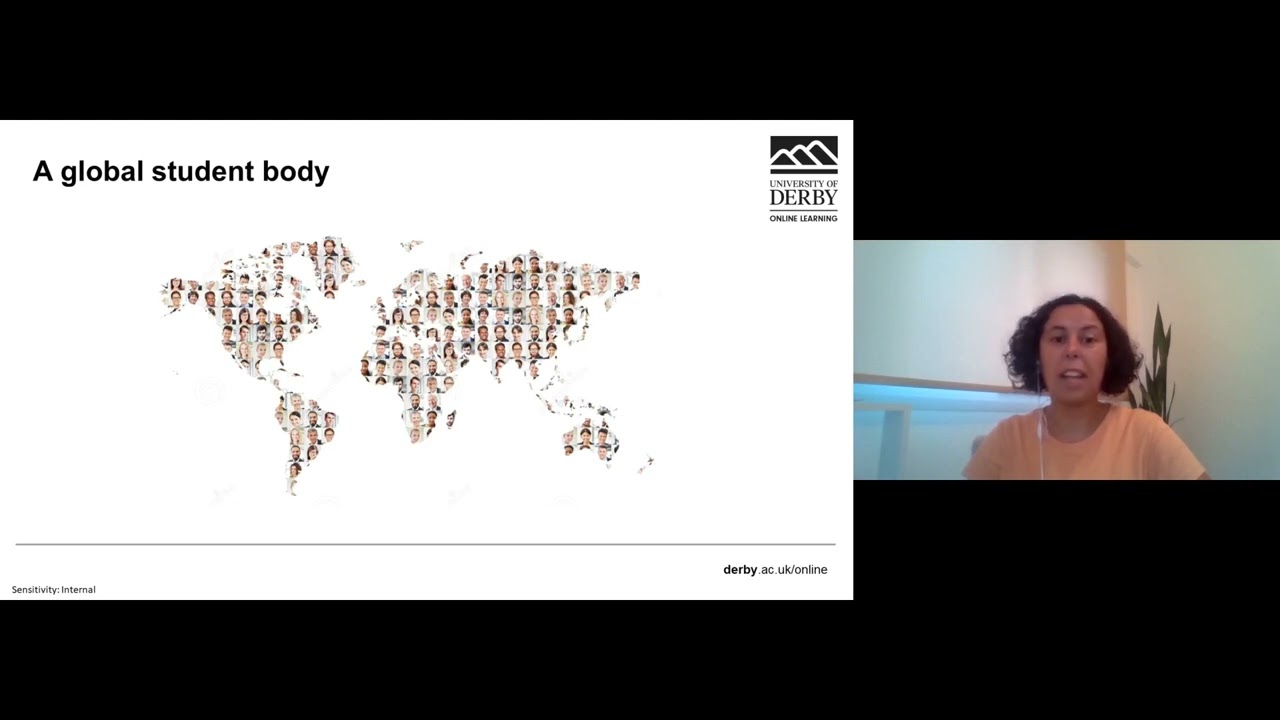
You'll also be part of a global and growing student body. We've got students from all across the world and it makes for an excellent opportunity to meet others and learn from their experience as well as contributing your own background and growing your own personal and professional networks.
Based on the latest rankings we're really pleased to come in at the top 20 based on the Guardian University Guide and in terms of satisfaction with the course we've achieved fourth place which is a huge achievement that we're very proud of.
Our students also have lots of positive things to say about their time with us and I think this final quote here from Amanda really captures what we try to embody as academics on the program. So I'd just like to focus on that section for now. Amanda says what I've enjoyed most is how friendly and willing the tutors are to help you. I'm also fortunate to have an excellent tutor for my final research paper who is always willing to help and is a lovely human being to chat to. I'm really glad you feel that way Amanda.
So as part as being at the University of Derby you'll also have access to a number of University services in a virtual setting. These will include things like the library, career services as well as the well-being centre.
The online learning modality really is here designed to make it work for you you'll be able to focus at a time and place that is suitable to you. We do recommend that these tips here will make your studies more achievable and more enjoyable, starting off by creating a space for you to study and perhaps carving out a particular time of day in the week to make sure that you can protect 20 hours of study time per week. You'll have opportunities to regularly engage and interact with your peers and tutors and we also encourage you to stay up to date with the latest announcements and additional resources and you can access all of this through the university learning portal and it also goes without saying but it also helps not to leave assessments to the last minute.
As part of your online community you'll have a number of asynchronous and synchronous opportunities to engage. These will take the shape of discussion forums where you can chat with others and also get feedback on your contributions to activities. You'll also have an opportunity to take part in live virtual webinars and these will be intended to present you with content related information as well as sessions dedicated to help with assignments. We appreciate that having students all across the world means that it's very difficult to find a time that will work for everyone which is why we always make sure that these sessions are recorded so that you have an opportunity to catch back on them when you've got time. In addition to these we use the standard emailing and whole telephone and virtual meetings with you to make sure that we can support you with your studies.
As well as all the academic support that you'll be getting you'll also be assigned a personal academic tutor who's your main point of contact to see you through from start to end of your studies with us. Your personal academic tutor is your go-to person for any kind of issues that you might have that are related to your studies, they'll be there to support you and signpost you to the most relevant places. In addition to academic support you'll also be able to draw on the networks that you'll be developing with your fellow students and for non-academic support queries we have a dedicated online learning advisory team who are here to support you with things like study patterns and fees and payment plans. You'll also have access to the University services that I mentioned before in terms of student well-being, the library, the careers, as well as the Union of Students. All students of the University also get access to Microsoft Office 365 as well as one terabyte worth of cloud storage and the student portal and virtual learning environment is accessible to you as long as you've got internet and a power connection.
Our online library has access to lots of online resources. It has access to databases such as library plus as well as more subject-specific databases such as Psych Info and Psych Articles.
The library team also run a number of live sessions where you're able to develop skills and learn to navigate the online library in the most effective way for you. Just like the live sessions for your courses these sessions are also recorded so don't worry if the times that are presented there don't work well for you, each module that you're studying will have core and recommended reading and these will all be fully accessible through the e-library platform.
One of the most exciting times of the academic year is when we get to celebrate your success and you're invited to come onto campus to meet us and it's just a very enjoyable day where we get to celebrate all the fruits of your hard work and big achievements. So we hope to be able to do this with many of you.
For now though I suggest that your next steps might involve checking out our website to see where you stand against the entry criteria, so that you can check the fees for the programs and see what payment plans might work for you and take a look at our next intake. If the MSc or PG Dip psychology program is something that is meaningful and worthwhile for you to do. I look forward to welcoming you on the program thank you for listening.
If you have any further questions you can contact-us.
The Psychology PG Dip is made up of six core 20 credits modules and one zero credit module, totalling 120 credits.
As a BPS accredited programme, group work is required as part of the BPS standards. This means that on Individual Differences, you will be required to work with other students in groups from the start of the trimester (week 1). Failure to engage with your group by the end of week 3 will result in you being dropped from the module and subject to a module cancellation fee.
Please note that our modules are subject to change - we review the content of our courses regularly, making changes where necessary to improve your experience and graduate prospects.
Discovering Online Learning: March 2026
Friday, 20 March 2026 12.00 - 13.00
During this hour long webinar, we'll take you through how online learning works and what you can expect as an online student with the University of Derby.
You can be assured of a supportive and structured learning experience with academic teams who are specialists not only in their area of psychology, but also in online learning delivery. Our dedicated online learner advisors will also provide you with non-academic support throughout the duration of the course. You’ll have access to an extensive online library of psychology resources, student webinars in key areas such as library skills and assessment writing, and other academic and wellbeing related services.
There are plenty of opportunities to interact with tutors and other students through online discussion forums, virtual classroom sessions, email and Microsoft Teams. You will also receive one-to-one support from a specialist supervisor when you begin your empirical research project.
Pace of study
The academic year is made up of three 10-week terms, known as trimesters. We recommend about 20 hours of study per week to complete one 20-credit module over a 10-week trimester.
If you opt to undertake the accelerated study plan whereby you will study two modules in one trimester, we recommend 40 hours of study per week.
Should you decide to study on the accelerated rate you should ensure that you have the capacity to fully engage with your studies and achieve the best grades and final award. If you choose to study on the accelerated rate, you will need to balance approximately 40 hours of study per week alongside your professional and personal life and commitments.
It may be useful to consider studying one module at the standard rate of study before deciding whether to then increase to the accelerated rate of study.
There will be 1/2 virtual classrooms over the 10 week trimester and if you are unable to attend you will be able to download the session to view in your own time.
Assessment method
This course is assessed through 100% coursework with a range of methods, such as essays, research reports, presentations, group work and practical reports.
Student support and guidance
Whilst we encourage our students to become independent, life-long learners, we also recognise that offering the right support and guidance will help you to achieve your goals. There is a wealth of support available to you at the University, from your dedicated Personal Tutor and Online Learner Advisor, through to our:
Develop@Derby for study, personal and employability skills
All these services, and more, are available to you as an online student at the University of Derby.
Who will teach you
Take a look at the programme co-leaders for this online Psychology Postgraduate Diploma course or explore all staff on this course.
Who will teach you
Dr Gulcan Garip
Programme Co-Lead in Psychology
Dr Gulcan Garip
Dr Gülcan Garip is the Programme Co-Lead for MSc Psychology and teaches on the MSc Health Psychology. Gülcan is a registered Chartered Psychologist with the British Psychological Society (BPS), a registered Health Psychologis...
Dr Natalie Zadurian is the Programme Co-Lead for the MSc and PGDip Psychology programmes. She teaches across both the undergraduate and postgraduate online psychology programmes, with specialisms in Health Psychology, Developmental Psy...
Lecturer in Psychology, Dr Boban (Bob) Simonovic, joined the University of Derby as a Lecturer in Psychology in November 2017, having previously worked as an associate lecturer (online), and as a teaching assistant on campus.
Hettie joined the University of Derby in May 2020. She gained her PhD in Psychology at the University of Lincoln in 2013 exploring the impact of simulated hearing loss on executive function, namely; impulsivity, sustained attention and...
Researcher and Lecturer in Health, Psychology and Social Care.
Dr Amelia Woodward
Dr Woodward is a researcher in the Health and Social Care Research Centre, she carries out research in issues relating to public health and primary care. She has a background in psychology and expertise in both quantitative and qu...
In 2021, Ann Kirkman completed her PhD at the University of Derby. The PhD focused on investigating the relationship between implicit and explicit measures of optimism and examining changes in them using positive psychology interventio...
Our Psychology Postgraduate Diploma course taster will give you an idea of how online learning works. It includes a selection of content from a course module so you can see what some of our learning material looks like.
You will need to complete a short form to access the course taster.
We believe that real-world experience is an essential part of academic success. Our partnerships with leading organisations across various sectors ensure our students gain valuable insights, hands-on opportunities, and access to the latest industry innovations.
Through collaboration with our industry partners, we bridge the gap between classroom learning and professional practice, preparing our graduates to thrive in competitive global markets.
industry partnership video video transcript
Careers
During this course you’ll study all the core areas of psychology to gain a deep understanding of the subject.
From here you can then choose which area you would like to specialise in and continue to further training. For example, you may want to consider our online MSc Health Psychology or online MSc Forensic Psychology courses which will introduce you to a range of psychology professional competencies. Other areas of psychology you can consider are sports, clinical, educational and occupational.
Utilise our Careers and Employment Service
Whilst you are a student at the University of Derby, and for three years after you graduate, our Careers and Employment Service can assist you with job search advice, CV creation, workshops and events, as well as one-to-one appointments with employment advisers to help with career planning and interview preparation.
Entry requirements
You will need:
60 credits in psychology at level 4 or above. If you don't have 60 credits in psychology, you can study our online University Certificate in Psychology, which can be completed in 12 months.
In addition, you will usually need one of the following:
An undergraduate degree with Honours (in any subject) from a UK university or equivalent overseas qualification - at least a 2:2
A Masters degree from a UK university or equivalent overseas qualification
A psychology degree which hasn't given you Graduate Basis for Chartership - at least a 2.2
An undergraduate degree from an overseas institution that is equivalent to the above UK qualifications. It is also important that you have a good standard of written and spoken English
If you have studied at another institution you may be able to translate some of this prior learning into credits (a maximum of two taught modules or 40 credits) towards this course. This is called Recognition of Prior Learning or RPL. This could potentially reduce the course length to a minimum of 12 months. Learn more about RPL.
English language qualifications
You’ll also normally require one of the following English language qualifications:
GCE O level English Language C
GCSE English C
If English is not your first language, or you have not successfully completed your highest level of qualification in English, you will need an English language qualification. For this course, you will need a minimum IELTS (International English Language Testing System) score of 6.0 or equivalent.
This figure would be the total cost of this course based on the fee in the current academic year. However, please note that fees normally increase in line with inflation and the University's strategic approach to fees, which is reviewed on an annual basis. The total fee you pay may therefore increase if your course lasts longer than one year.
If you are required to undertake any associate study or additional study as a condition of your offer for the programme, please be aware that the cost for this may be in addition to the programme cost stated above.
In order for your application to be assessed, you will need to provide the following documents when you apply:
Official photo identification such as a passport or driving licence
Copies of certificates and transcripts or a letter of testimony for previous qualifications*
*Documents not in English or Welsh must be accompanied by a certified translation by a professional translator/translation company. Each translation must contain:
Confirmation from the translator that it is an accurate translation of the original document
The date of the translation
The full name and signature of the translator, or an authorised official of the company
Please note: failure to submit any documentation when requested, may result in your application being withdrawn.
Application deadlines
All of our online courses have set start dates throughout the year. We require time to review your application and get back to you with a response before your course starts. Take a look at information regarding applying for an online course to see full details of deadlines and term dates.